Attention Investors: Understanding the Math Behind Investment Property Decisions
When evaluating an investment property, one of the biggest challenges investors face is deciding what type of return matters most. Some properties are designed to cash flow, while others may offer stronger appreciation over time. Understanding a few basic calculations can help guide your decision and avoid costly mistakes.
Let’s walk through a simple example to show how the math works.
Step 1: Calculate Gross Income (GI)
Assume you’re considering a 3-bedroom, 2-bath home with a purchase price of $100,000 that rents for $1,000 per month.
To calculate annual gross income:
-
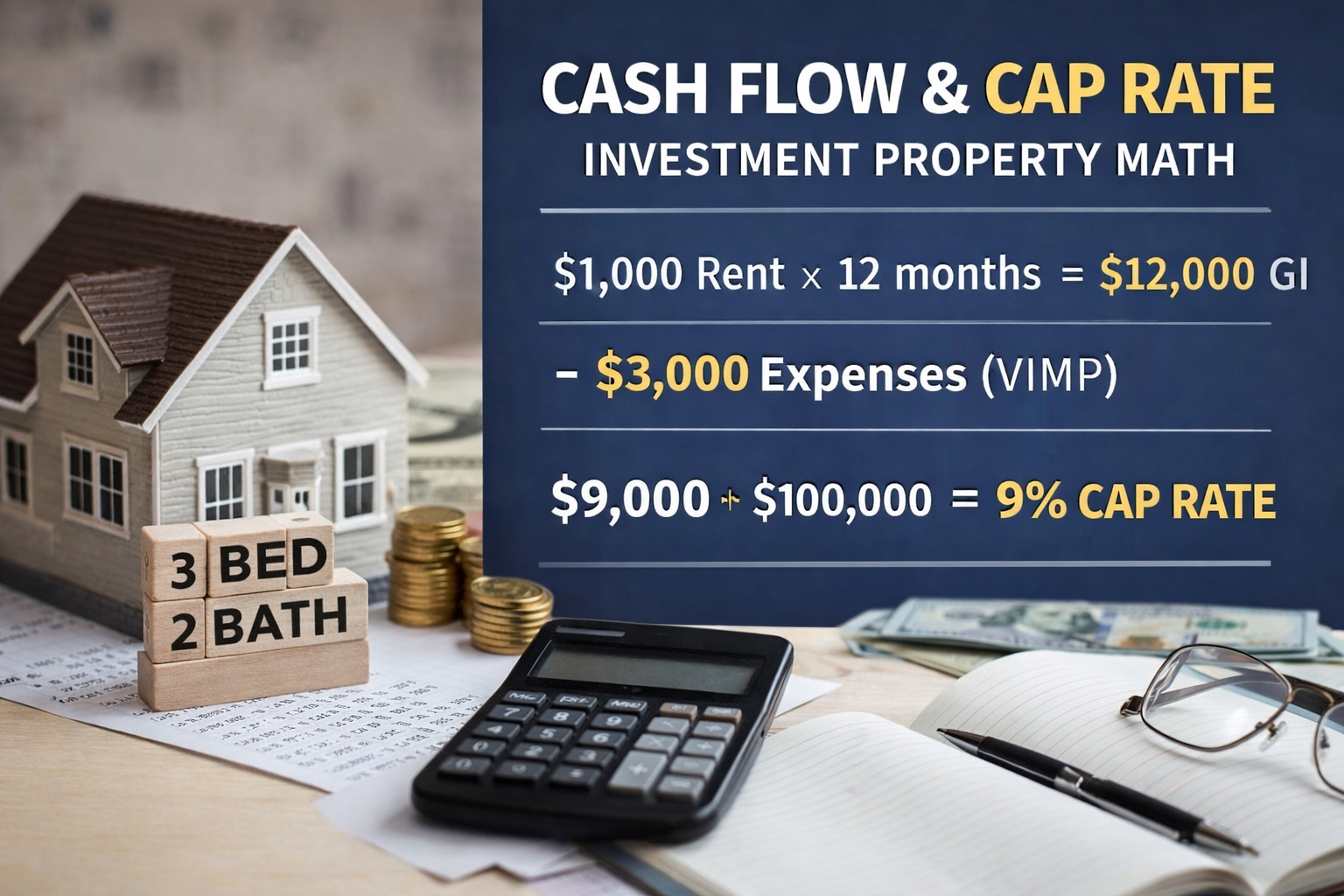
$1,000 × 12 months = $12,000 Gross Income (GI)
This is the total rent collected before expenses.
Step 2: Calculate Net Operating Income (NOI)
Next, we need to account for operating expenses. A simple and commonly used expense acronym is VIMP:
-
Vacancy
-
Insurance
-
Maintenance
-
Property Taxes
(You may also include management, utilities, or HOA fees if applicable.)
In this example, let’s assume total annual VIMP expenses equal $3,000.
Now subtract expenses from gross income:
-
$12,000 GI – $3,000 expenses = $9,000 NOI
Your Net Operating Income (NOI) is the income the property produces before financing costs.
Step 3: Calculate the Cap Rate (Important Correction)
The capitalization rate (cap rate) tells you the return on the purchase price of the property — not the rent amount.
Cap Rate Formula:
NOI ÷ Purchase Price
Using our example:
-
$9,000 ÷ $100,000 = 9% Cap Rate
This means the property generates a 9% return based on its operating performance, before financing.
Step 4: Understanding Cap Rate vs. Interest Rate Spread
One of the most important concepts for investors is the spread between the cap rate and your interest rate.
-
If your cap rate is higher than your interest rate, the property is more likely to cash flow.
-
If your interest rate is higher than your cap rate, cash flow may be tight or negative — even if the property appreciates.
Example:
-
Cap Rate: 9%
-
Loan Interest Rate: 7%
-
Positive spread: 2%
A positive spread generally indicates a healthier investment and provides a buffer against rising expenses or vacancies.
On the other hand:
-
Cap Rate: 6%
-
Interest Rate: 7.5%
-
Negative spread: –1.5%
This scenario may still work for appreciation-focused investors, but it carries more risk and requires careful analysis.
Why This Math Matters for Investors
Understanding GI, NOI, cap rate, and interest rate spread allows investors to:
-
Compare properties objectively
-
Identify true cash-flow potential
-
Avoid overpaying for underperforming assets
-
Align investments with short-term income or long-term appreciation goals
Not every deal is meant to cash flow, and not every deal is meant to appreciate — but the numbers should always support the strategy.